Creatine Mini-Loading: How to Saturate Faster Without Full Loading Side Effects
By The Creatine Canada Research Team — Evidence-based supplement analysts
Yes — a creatine fast loading protocol can mean using a moderate “mini-loading” approach, typically 10 g per day split into 2 doses, to saturate muscle creatine faster than 3–5 g per day without the higher side-effect risk of a full 20 g loading phase. For most people, it is the best middle ground between speed, comfort, and simplicity.
Evidence-based · Cites 4 sources · Editorial standards
Key Takeaways
- A creatine mini-loading protocol usually means 10 g/day for 7-14 days, then 3-5 g/day maintenance.
- Mini-loading saturates muscle faster than standard dosing, but more gently than a full 20 g/day loading phase.
- Split 10 g into two 5 g doses to reduce stomach upset and improve tolerance.
- Creatine monohydrate is still the best-supported form for fast saturation, performance, safety, and value.
- Take creatine daily, including rest days; exact time of day matters far less than consistency.
- If full loading causes bloating or diarrhea, moderate loading is often the easiest fix.
- Most people notice earlier workout benefits within 1-2 weeks on mini-loading, versus closer to 3-4 weeks on standard dosing.
Creatine fast loading, defined: the quickest low-side-effect route to saturation
A creatine fast loading protocol is a dosing strategy that raises muscle creatine stores faster than standard 3-5 g daily use, and a mini-loading approach of 10 g per day is the most practical moderate option for many people. In plain terms, you are trying to reach muscle saturation — the point at which your muscles are holding near-maximal creatine stores — sooner, so performance benefits show up earlier.
The classic loading phase is well known: about 20 g per day, usually split into four 5 g doses, for 5-7 days, followed by 3-5 g per day. The 2017 ISSN position stand concluded that this approach can elevate muscle creatine stores more rapidly than lower-dose protocols. But rapid loading is not all-or-nothing. A creatine mini loading or creatine moderate loading protocol aims for the middle: faster saturation than standard daily dosing, with fewer digestive complaints than full loading.
That is why many people search for terms like creatine quick loading, creatine fast saturation, and creatine loading without side effects. They want the speed of a loading phase without the common downsides of taking 20 g a day. In practice, 10 g per day split into two servings is the simplest version of a faster creatine loading method that still feels easy to follow.
For beginners, the key point is simple: you do not need to load creatine at all, but if you want it to work sooner, mini-loading is a sensible compromise. Standard 3-5 g daily use still works; it just takes longer to saturate muscle stores. If you want a personalised baseline, use a creatine dosage calculator and compare the result to the mini-loading options below.
If you are new to the supplement entirely, start with what creatine is and how it works, then come back to this guide for the faster-dosing strategy. The short version is that mini-loading is not a different supplement or a new form of creatine. It is simply a smarter dosing pattern for people who want results sooner without pushing intake as high as full loading.
Why mini-loading works: phosphocreatine, ATP, and the case for faster saturation
Creatine mini-loading works because taking more creatine per day raises intramuscular creatine and phosphocreatine stores faster, which improves your ability to regenerate ATP during short, intense efforts. ATP, or adenosine triphosphate, is the immediate energy currency your muscles use for sprinting, lifting, jumping, and repeated hard intervals.
Phosphocreatine is the stored form that helps rapidly rebuild ATP when effort is explosive and rest periods are short. When muscle creatine stores rise, your body can restore ATP more efficiently between contractions. That is the main reason creatine reliably helps with high-intensity exercise performance, training volume, and over time, strength and lean mass gains.
The mechanism matters because it explains why dosing affects timeline, not whether creatine works. If you take 3-5 g daily, you still increase muscle creatine stores. It simply happens more gradually. If you take 20 g daily for about a week, saturation happens faster. A creatine 10g per day protocol sits between those two: it moves the process along meaningfully faster than maintenance-only dosing, but with less intestinal load per day than classic loading.
The ISSN position stand and the broad evidence summary from Kreider et al. (2017) support the basic saturation model, and Examine.com’s creatine evidence summary reflects the same practical takeaway: higher short-term doses speed saturation, while lower doses get there more slowly.
There is also a tolerance angle. Creatine itself is not a stimulant, and it does not “kick in” acutely the way caffeine does. Its effects depend on tissue storage. That is why a faster saturation strategy makes sense for people starting a new training block, returning from time off, or trying to peak gym performance sooner. You are not chasing a one-time pre-workout effect; you are filling the tank faster.
For a deeper look at this energy system, see creatine and ATP and creatine muscle saturation. Those guides explain why fast loading changes the speed of results more than the final destination.
The best creatine fast loading protocol for most people
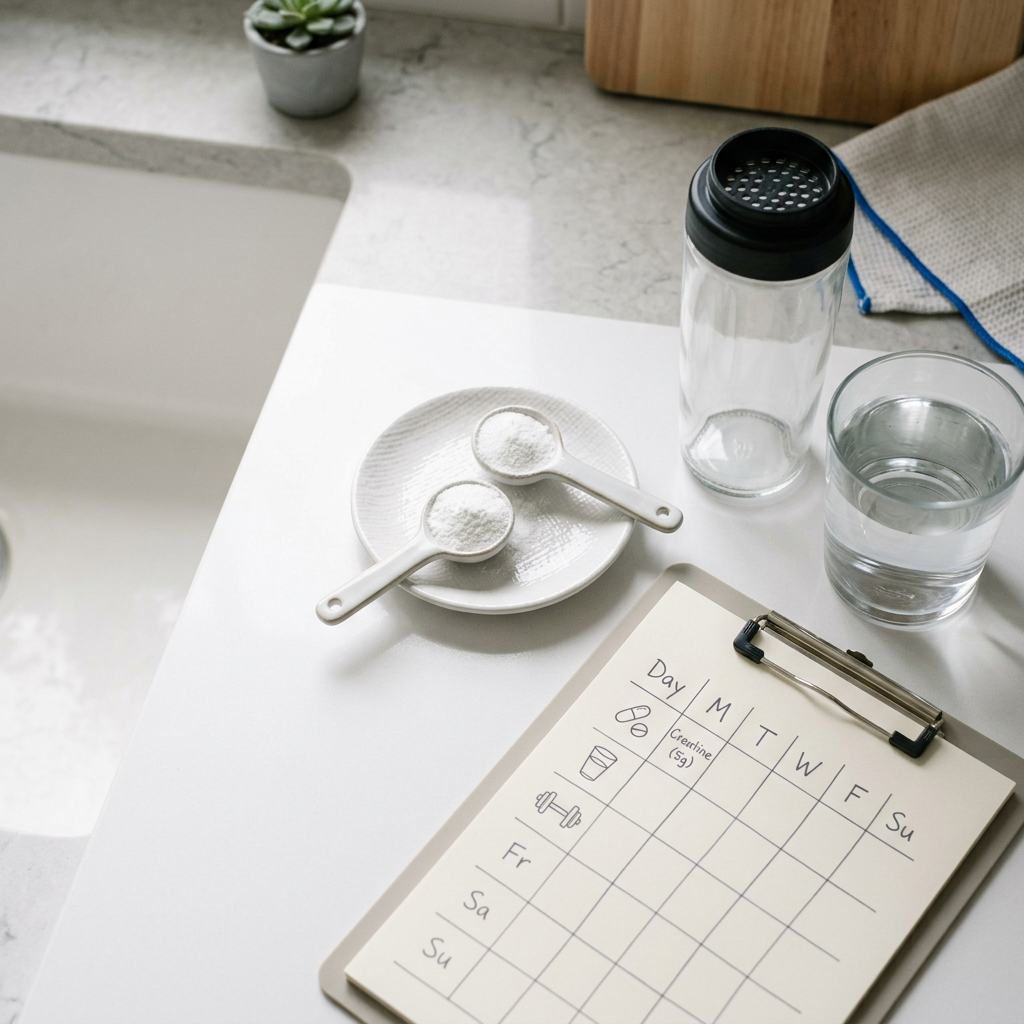
For most lifters, the best creatine fast loading protocol is 10 g per day split into two 5 g doses for 7-14 days, followed by 3-5 g per day for maintenance. This is the clearest answer for anyone searching creatine moderate loading or creatine loading without side effects.
Here is the practical structure:
- Choose creatine monohydrate. It is the most studied, most effective, and most cost-effective form. Do not assume HCL, buffered creatine, or gummies will saturate muscle better simply because the marketing sounds more advanced.
- Take 5 g in the morning. Mix it in water, a shake, or another drink you tolerate well.
- Take 5 g later in the day. Many people place the second dose after training or with a meal.
- Continue daily for 7-14 days. Seven days is a solid fast-start option; fourteen days is more conservative and often more comfortable for sensitive stomachs.
- Drop to maintenance. After mini-loading, take 3-5 g per day every day to stay saturated.
If your goal is to saturate even faster and you tolerate creatine well, the full loading approach remains about 20 g per day split into four 5 g doses for 5-7 days. If your goal is maximum simplicity and you do not care how fast it works, standard 3-5 g daily is enough. The middle-ground protocol is useful because it balances all three variables that actually matter: speed, comfort, and compliance.
Here is a quick comparison:
| Protocol | Daily dose | Typical structure | Speed to saturation | Side-effect risk | Best for |
|---|---|---|---|---|---|
| Standard daily use | 3-5 g | 1 dose daily | Slowest | Lowest | People who do not mind waiting |
| Mini-loading | 10 g | 2 x 5 g | Moderate-fast | Low-moderate | Most beginners and general gym users |
| Full loading | 20 g | 4 x 5 g | Fastest | Highest | People who want maximum speed and tolerate it well |
If you want a more traditional loading guide, see creatine loading phase. If you want the broader daily framework, read how to take creatine.
How much to take by body weight, training goal, and sensitivity
The right creatine fast saturation dose depends less on sex and more on body size, muscle mass, and how aggressively you want to reach saturation. Most adults do well with either 10 g per day as a mini-load or 3-5 g per day as maintenance, but larger athletes often sit near the top end once the loading window ends.
The classic research framework often uses relative loading at roughly 0.3 g/kg/day for 5-7 days, then about 0.03 g/kg/day for maintenance. In real life, that usually gets simplified into scoop-based advice because that is what people can follow consistently.
Use this practical table as a starting point:
| Body weight | Mini-loading option | Maintenance after mini-load | Good fit for |
|---|---|---|---|
| Under 60 kg | 8-10 g/day split in 2 doses | 3 g/day | Smaller adults, some women, cautious beginners |
| 60-90 kg | 10 g/day split in 2 doses | 3-5 g/day | Most gym-goers |
| Over 90 kg | 10-15 g/day split in 2-3 doses | 5 g/day | Larger lifters, team-sport athletes, high lean mass |
If you are specifically looking for a creatine 10g per day protocol, the 60-90 kg bracket is where it fits best with almost no modification. For someone at 75 kg trying to get quicker results before a strength block, 5 g with breakfast and 5 g after training for 10 days is a practical plan. For a 55 kg beginner who is worried about stomach upset, starting at 4 g twice daily for 10-14 days can be more comfortable. For a 100 kg power athlete, 5 g three times daily for a short 5-7 day period may be reasonable if tolerance is good.
Your goal matters too. Strength and power athletes usually care more about faster saturation than casual lifters. People cutting body fat may still want mini-loading if they want to support training quality sooner. Endurance athletes need more nuance because early water-weight shifts can matter in weight-sensitive events.
If you want a more detailed calculation, use our creatine dosage calculator or read how much creatine per day. Those tools help you choose between body-weight logic and the simpler 3 g, 5 g, 10 g framework most people actually follow.
When to take it, and what to expect in week 1, week 2, and beyond
Take creatine at any time you can do consistently, because daily intake matters far more than exact timing, and mini-loading usually brings noticeable training effects sooner than standard dosing. That is the short answer for anyone wondering whether a faster creatine loading method has to be timed around workouts.
The evidence does not support obsessing over a narrow anabolic window for creatine. You can take it with breakfast, post-workout, or with any regular meal. If splitting 10 g per day, two evenly spaced 5 g doses are simple and easy to tolerate. Taking it with food can help some people who get mild stomach discomfort on an empty stomach. For more on this, see when to take creatine and with or without food.
Here is a realistic mini-loading timeline:
- Days 1-3: You will not feel a stimulant-like effect. What may change first is routine consistency, better hydration habits, or mild water retention in muscle.
- Days 4-7: Some people begin noticing slightly better repeat sprint performance, one or two extra reps at a given weight, or less drop-off across hard sets.
- Week 2: This is when mini-loading often starts to clearly separate itself from standard 3-5 g daily dosing. Muscles may feel a bit “fuller,” and training volume often improves.
- Weeks 3-4: If your training and nutrition are in place, strength progression and lean mass changes become more noticeable. The benefit now reflects both saturation and better training quality.
How do you know it is working? The best markers are not dramatic. Look for:
- better repeat effort on short rest
- one to three more total reps across working sets
- slightly improved sprint, jump, or bar-speed consistency
- a small increase in scale weight from intracellular water, not fat
If you want to understand the timeline in more depth, see how long creatine takes to work and realistic creatine results. The key expectation to set is that mini-loading speeds the ramp-up, but the real payoff still comes from what better training accumulates into over weeks and months.
Who mini-loading is best for: beginners, women, older adults, and athletes
Creatine mini-loading is best for people who want faster saturation but do not want the inconvenience or side effects that can come with a full 20 g loading phase. That includes a surprisingly wide range of users.
Beginners often do well with mini-loading because it is easy to follow and less intimidating than four doses a day. A standard beginner mistake is thinking creatine must be loaded aggressively to work. It does not. A moderate protocol helps new users build the daily habit without turning the first week into a compliance test. If that is you, read creatine for beginners after this guide.
Women can use the same creatine mini-loading logic as men. Creatine dosing is not meaningfully different just because of sex; body size and tolerance matter more. Many women prefer 8-10 g per day split in two doses during a mini-load, followed by 3-5 g per day. If you are worried about “bulking,” the concern is usually misplaced: initial scale changes are mostly water held inside muscle, not fat gain. See creatine for women for the full breakdown.
Older adults may benefit from faster saturation if the goal is to support resistance training, muscle function, and recovery sooner, but the same sensible caution applies: start lower if digestion is sensitive or medications complicate the picture. A 3 g to 8 g mini-load may be more comfortable for some older users before settling into daily maintenance. More on that in creatine for older adults.
Athletes in power, sprint, team, and repeated high-intensity sports are often ideal mini-loading candidates. Hockey, football, rugby, CrossFit, sprinting, and lifting all place a premium on rapid ATP regeneration. Mini-loading can make sense before a training camp, strength block, or return-to-play period when fast saturation matters but gastrointestinal comfort still matters too.
Who may prefer standard dosing instead? Anyone highly sensitive to digestive changes, anyone who simply does not care about faster uptake, and anyone whose sport makes even small short-term water-weight shifts undesirable. In those cases, 3-5 g daily remains a perfectly evidence-based path.
Side effects, safety, and how to choose a good creatine in Canada
Creatine mini-loading is generally well tolerated in healthy people, and reducing the daily dose from 20 g to 10 g often lowers the chance of bloating, loose stools, or stomach discomfort. That is the main practical reason this protocol exists.
The 2017 ISSN position stand and the 2021 JISSN review on misconceptions both support creatine monohydrate as a safe, effective supplement for healthy individuals when used appropriately. The most common issues are not dangerous side effects but dose-related tolerance problems: taking too much at once, using too little water, or dry scooping. If you want a full safety review, read is creatine safe, creatine digestive side effects, and kidney concerns explained.
To reduce side effects during mini-loading:
- split doses instead of taking 10 g all at once
- mix thoroughly in enough fluid
- take with meals if your stomach is sensitive
- avoid unnecessary add-ons that irritate digestion
- stay normally well hydrated rather than force-drinking extreme amounts
In Canada, product quality matters because creatine is easy to market and easy to dress up with fluff. Look for:
- Creatine monohydrate as the main or only active ingredient
- NPN, or Natural Product Number, which indicates the product has been licensed by Health Canada as a natural health product
- third-party testing when possible, especially for competitive athletes concerned about contamination risk
- clear serving-size labelling in grams, not vague “scoops” only
For buying help, browse our best creatine rankings, creatine brand reviews, and creatine product catalog. If you want to compare monohydrate with flashier forms, our guide on best type of creatine shows why monohydrate still wins in 2026.
For external reading, the Mayo Clinic overview is a useful general summary for mainstream readers, and the misconception paper by Antonio et al. (2021) addresses several lingering fears directly.
The mistakes that ruin fast saturation, plus the myths that still confuse people
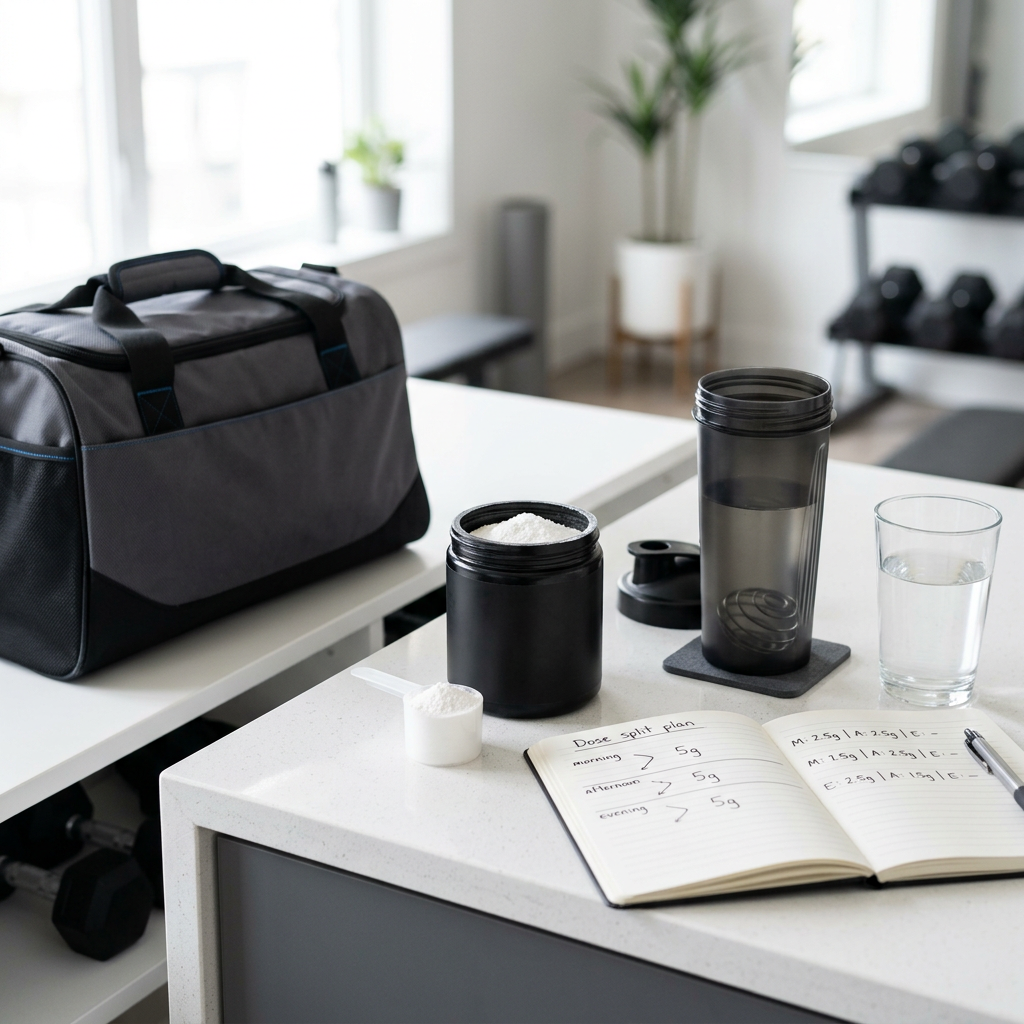
The biggest mistakes with creatine fast loading are taking too much at once, choosing flashy forms over monohydrate, stopping on rest days, and expecting a stimulant-like feeling. Most problems people blame on creatine are really dosing or expectation errors.
Here are the most common mistakes:
- Taking 10 g in one shot. If you are using a mini-load, split it. Two 5 g servings are usually easier on the stomach.
- Skipping maintenance after loading. Saturation is not permanent. After your mini-load, keep taking 3-5 g daily to maintain elevated stores.
- Missing rest days. Creatine works by keeping stores topped up, so consistency matters more than workout timing.
- Buying expensive “advanced” forms. Monohydrate remains the reference standard for efficacy, safety, and value.
- Confusing water gain with fat gain. Early weight gain is usually intracellular water stored in muscle, not body fat.
- Declaring yourself a non-responder too early. Poor training, underdosing, or inconsistency explain many apparent failures.
Now the myths:
Myth: You must do a full loading phase for creatine to work. False. Standard dosing works; loading only changes speed.
Myth: Mini-loading is pointless because only 20 g/day works fast. False. Moderate loading still speeds saturation relative to 3-5 g/day.
Myth: Creatine causes dehydration and cramps. The broader evidence does not support creatine as a cause of dehydration in healthy users; hydration habits still matter, but creatine itself is not a diuretic.
Myth: Creatine is hard on healthy kidneys. In healthy people, creatine monohydrate is generally considered safe, though blood creatinine can rise because creatine metabolism affects that lab marker. That does not automatically mean kidney damage.
Myth: Women should take less because creatine is a “male” supplement. False. Creatine is not a hormone and is not sex-specific.
For myth-by-myth detail, see creatine myths debunked, myths vs. facts, and why creatine may not seem to work. These pages help separate true non-response from simple protocol mistakes.
Mini-loading vs. full loading vs. standard daily use: which should you actually choose?
You should choose mini-loading if you want a faster creatine saturation method than 3-5 g daily but want fewer side effects and less hassle than 20 g daily. For many people, that makes it the most rational option, not just the compromise option.
Choose standard daily dosing if you value simplicity above all else. One daily 3-5 g serving is easy, cheap, and highly sustainable. The downside is patience: saturation arrives more slowly.
Choose full loading if speed is your only priority and you know you tolerate creatine well. This is most useful when a performance block starts immediately, when an athlete wants the quickest rise in stores, or when a short lead-in period matters. The trade-off is that four daily doses are inconvenient and more likely to cause bloating or loose stools.
Choose mini-loading if you want the sweet spot. It is especially good for:
- beginners who want results sooner without overcomplicating the plan
- women and smaller users who dislike the idea of 20 g a day
- athletes who want rapid uptake but cannot risk digestive disruption during training
- people returning to creatine after time off
One overlooked advantage of mini-loading is adherence. In sports nutrition, the protocol that works on paper is not always the protocol people will actually follow. Two servings per day for a week or two is much easier than remembering four. That matters because the best creatine protocol is the one you will do every day.
If you are comparing formats as well as protocols, powder remains the easiest route for flexible dosing. Capsules can work, but swallowing enough capsules to equal 10 g per day is often annoying and more expensive. Gummies may be convenient, but hitting a true mini-load with them can require a lot of pieces and added cost. For most Canadians, plain monohydrate powder remains the default best buy.
Need help choosing a product before you start? Use our best creatine rankings and brand reviews to narrow down a short list, then check labelling for monohydrate, NPN, and clear dose disclosure.
A simple 14-day creatine quick loading plan you can start today
If you want a concrete creatine quick loading plan, use 10 g per day split into two 5 g doses for 14 days, then continue with 3-5 g per day. This is the easiest step-by-step template for most readers.
- Buy plain creatine monohydrate. Check the ingredient list and serving size. Avoid underdosed blends.
- Measure accurately. Use a scoop only if the label clearly states the gram amount per scoop; otherwise use a kitchen scale. If you need help, read how to measure creatine.
- Days 1-14: Take 5 g with breakfast and 5 g later in the day, ideally after training or with dinner.
- Training days: Keep the split the same. Do not “save it all” for post-workout.
- Rest days: Take both doses anyway. Saturation depends on continuity.
- Day 15 onward: Switch to 3-5 g daily for maintenance.
- Hydration: Drink to normal thirst and ensure your day-to-day intake is reasonable. Read how much water to drink with creatine if you want specifics.
- Track outcomes: Log body weight, key lifts, sprint repeatability, or total reps across sets.
Example plans:
- 65 kg recreational lifter: 5 g morning + 5 g post-workout for 10 days, then 3 g daily.
- 80 kg beginner: 5 g breakfast + 5 g dinner for 14 days, then 5 g daily.
- 95 kg strength athlete: 5 g breakfast + 5 g pre- or post-workout for 7-10 days, then 5 g daily.
If 10 g feels too much on day one, start at 3 g twice daily for several days, then increase to 5 g twice daily. That still counts as a moderate ramp and can improve tolerance. If even that bothers your stomach, abandon the fast protocol and use 3-5 g daily. There is no prize for suffering through a loading strategy you hate.
This step-by-step plan is intentionally boring, because boring is what works. Creatine rewards consistency, not cleverness.
Bottom line: is creatine mini-loading worth it?
Yes — creatine mini-loading is worth it if you want faster saturation than standard dosing and fewer side effects than a full loading phase. For most people, 10 g per day split into two 5 g doses for 7-14 days is the best creatine fast loading protocol to try first.
It works because creatine benefits depend on muscle saturation, and a moderate increase in daily intake fills that tank faster than 3-5 g daily alone. The result is a quicker path to the training benefits creatine is known for: improved repeated high-intensity performance, better training volume, and over time, greater gains in strength and lean mass when combined with good programming.
It is not magic, and it is not required. If you are patient, maintenance-only dosing still works. If you tolerate high intakes and want the absolute fastest route, full loading still exists. But mini-loading is the protocol that best balances real-world priorities: speed, comfort, adherence, and value.
Keep the final checklist simple:
- use creatine monohydrate
- split 10 g into two doses
- do it daily for 7-14 days
- continue with 3-5 g daily afterward
- judge success by better training, not by a dramatic feeling
If you want to keep reading, the next most helpful guides are loading phase, maintenance dose, how long it takes to work, and the complete creatine guide. Those pages will help you build the rest of your routine around a protocol that is already proven and easy to execute.
Creatine Mini-Loading at a Glance
- 10 g/day Typical mini-loading dose — Usually split into 2 servings of 5 g
- 7-14 days Common mini-loading duration — Then switch to maintenance
- 3-5 g/day Maintenance dose after loading — Taken daily, including rest days
- 20 g/day Classic full loading benchmark — Usually split into 4 doses for 5-7 days
Frequently Asked Questions
What is a creatine mini-loading protocol?
A creatine mini-loading protocol is a moderate loading strategy, usually 10 g per day split into two doses, used to saturate muscle creatine faster than standard 3-5 g daily use. It is designed to be quicker than maintenance-only dosing but easier to tolerate than a full 20 g loading phase.
Is 10 g of creatine per day enough to load faster?
Yes, 10 g of creatine per day is enough to load faster than standard maintenance dosing. It will not usually saturate muscle as fast as 20 g per day, but it is a practical middle-ground approach that often reduces bloating and digestive discomfort.
How long should I use a creatine fast loading protocol?
Most people can use a creatine fast loading protocol for 7-14 days before switching to maintenance. Shorter periods are more aggressive, while longer mini-loading periods are often more comfortable for people with sensitive digestion.
Do I need to split creatine mini-loading doses?
Yes, splitting creatine mini-loading doses is usually the smartest approach. Taking two 5 g servings instead of one 10 g serving tends to improve tolerance and lowers the chance of stomach upset or loose stools.
Can I saturate creatine faster without full loading side effects?
Yes, that is exactly why creatine mini-loading exists. A moderate protocol such as 10 g per day split into two doses usually speeds saturation meaningfully compared with 3-5 g daily while causing fewer side effects than 20 g per day.
Is creatine mini-loading better than a full loading phase?
Creatine mini-loading is not better for absolute speed, but it is often better for comfort and compliance. Full loading is still the fastest method, while mini-loading is usually the better overall choice for people who want a balance of faster uptake and fewer digestive issues.
Should beginners use a creatine quick loading method?
Yes, beginners can use a creatine quick loading method, but they do not have to. Mini-loading is often a good beginner option because it is simple and moderate, whereas full loading can feel unnecessary and may increase the chance of mild side effects.
Does creatine mini-loading cause bloating?
Creatine mini-loading can cause mild bloating in some people, but it is generally less likely to do so than full loading at 20 g per day. Splitting the dose, mixing it well, and taking it with meals can help reduce the risk.
What form of creatine is best for fast saturation?
Creatine monohydrate is the best form for fast saturation because it is the most studied and the reference standard used in the loading research. There is no strong evidence that HCL, buffered creatine, or other forms saturate muscle better in real-world use.
Do I keep taking creatine after mini-loading?
Yes, you should keep taking creatine after mini-loading if you want to stay saturated. The usual next step is 3-5 g per day every day, including rest days, because stopping completely will eventually let muscle stores drift back down.